sexta-feira, 15 de janeiro de 2010

Morte

Smert'

Desde o nascimento, a única certeza que qualquer ser vivo tem é a de que vai morrer. Encaramos a morte como o oposto da vida, e, embora ela seja algo tão comum no mundo em que vivemos, ainda sofremos quando alguém, principalmente um ente querido, morre. A dor é sempre certa, por mais que saibamos que este é o destino de todos os seres vivos. Ora, às vezes me surpreende por que tanto sofremos, porque encaramos a morte como o antônimo de vida se ela é tão certa e a todos vem. Os astecas, por exemplo, viam a morte e a vida como sinônimos, não como um ciclo, ou reencarnação, mas como uma consequência da vida. Eles enxergavam todo o universo e os seres humanos como um único sistema, em que nosso sangue lubrifica as engrenagens que movem o cosmos. Para que cada dia amanhecesse, alguém tinha que ser sacrificado, e para muitos isso era uma honra. Morrer em campo de batalha também era uma honra, pois os mortos iam ter com o próprio deus do Sol e da guerra, Huitzilopochtli. Talvez nenhum povo tenha sido tão fascinado com a morte como os astecas.

S togo zhe momenta kogda my rodilis’, edinstvennaja uverennost’ chto u nas est’ v zhizn’ – eto chto my umrem. Smert’ dlja nas kazhetsja naprotiv zhizni, hotja ona takaya obychnaya v mire, gde my zhivem, chto nam eshche bol’no kogda kto-to, osobenno kotorogo my ochen’ lyublili, umiraet. Bol’no vsegda kogda eto sluchaetsja, hotja my znaem chto eto dlja vseh kto zhivet. Nu, inogda mne udivitel’no pochemu nam tak bol’no, pochemu nam kazhetsja smert’ – eto antonim zhizni dazhe esli horosho znaem chto ona v kontse kontsov budet. Atstekam, naprimer, smert’ i zhizn’ byli sinonimami, ne tsikl ili reinkarnatsija, no prosto kak sledstvie samoj zhizni. Oni videli vsyu vselennuyu i chelovechestva kak budto odna i ta zhe sistema, v kotoroj nasha krov’ smazyvaet zubchatye peredachi s kotoryh kosmos rabotaet. Chtoby solntse kazhdym utrom bylo, kogo-to prinosili v zhertvu i dlja mnogih eto bylo chest’. Umirat’ v vojne tozhe chest’, potomu chto te korotye umirayut poshli by k bogu Solntsa i vojny, Uitsilopochtli. Mozhet byt’ nikakim lyudiam kak atstekam smert’ kazalas’ takoj zamechatel’noj.

A verdade é que não existiamos como somos antes de nascer, mas já existíamos nesse mundo enquanto matéria, o nascimento é uma transformação, a vida é um processo e a morte é o retorno. Como princípio, meio e fim que a tudo atinge, quem hoje chora por quem morreu, um dia também irá morrer, assim como todos que vivem. Muitas vezes a morte é um alento, uma dádiva, quando a condição de ser vivente é mais dolorosa do que tudo, quando viver não vale a pena e a morte é um descanso eterno, das dores, das aflições, da agonia. As causas da própria morte fazem parte desse processo denominado vida, e a ocasião é uma consequência de nossas ações, por mais que às vezes pareça arbitrário. Um suicida não escolheu sua morte na hora em que bem quis mas sim porque toda a sua vida conspirou para aquele momento. Há quem diga que só se morre quando tem que morrer, e até o suicídio cai nessa resolução, posto que para que isto aconteça, o suicida deve estar em condições de dar cabo à própria vida. Se o suicida não tivesse que morrer naquela hora, quem sabe ele estaria feliz bebendo com os amigos num barzinho, ou numa viagem, trabalhando, fazendo planos... A própria vida é uma morte lenta, muito lenta, já que velhice mata. É como se começássemos a morrer a partir do nascimento, e o que fazemos até então é o que produz o momento derradeiro.

Delo v tom chto nas ne bylo do rozhdenija, no my uzhe byli v etom mire kak priroda, rozhdenija – eto transformatsija, zhizn’ – eto protsess a smert’ – vozvrashchenie. Kak nachalo, seredina i konets kotorie vseh dohodit, kto segodnja plachet dlja kogo kto umer, zavtra umret, kak vse ostal’nye. Inogda smert’ – eto uteshenie, chudo, kogda zhit’ uzhe zrja, smert’, togda, vechnyj otdyh, ot bol’nej, pechalej, agonii. Prichiny smerti javljayutsja s togo zhe protsessa kotoryj my nazyvaem zhizn’, a sobytie – eto sledtsvie nashih dejtsvij, hotja eto inogda kazhetsja narochno. Kto sam sebja ubyvaet samoubijstvom ne vybral moment svoej smerti prosto narochno no po tomu, chto vsja svoja zhizn’ konspirirovala do togo momenta. Schitaetsja chto tot kto umiraet, umiraet potomu chto vremja doshlo, i dazhe samoubijstvo sovpadaet v etom kontekste, iz-za togo, chto eto tol’ko sluchaetsja kogda chelovek umeet zakonchit’ svoyu zhizn’. Esli etot chelovek ne dolzhen byl umirat’ v tot moment, on byl by, dopustim, schastliv v bare s druz’jami s kruzhkami piva, ili puteshestvoval by, na rabote byl by, planiroval chto-nibud’... Zhizn’ sama medlennaja smert’, ochen’ medlennaja, razve starost’ ubyvaet. Eto kak budto my nachinalis’ umirat’ s rodzhenija, a to chem my zanimaemsja vsyu zhizn’ – eto put’ k poslednomu momentu.

Talvez por isso os astecas achavam a vida e a morte tão próximas, e o fato de eles já não mais existirem mostra o quão relativo tudo isso é. Assim como eles morreram, seus inimigos também morreram, assim como nós também morreremos, não há diferença, é só uma questão de tempo.

Vozmozhno imenno poetomu atsteki dumali chto zhizn’ i smert’ takie blizkie, a fakt chto atstekov uzhe netu pokazyvaet kak otnositel’nyj nash mir est’. Kak oni umerli, ih vragi tak zhe umerli, kak my tozhe umrem, bez raznitsy, eto prosto zavisit ot vremeni.


Tanja, ja voobshche ne znal chto skazat’ kogda ja uznal chto tvoj ded umer, hotja vse chto ja tut napisal ja uzhe tebe skazal. Vot tak ja ponimayu smert’, vot tak zhe moja mama umerla, uzhasnoj smert’yu, a ej smert’ ukazalas’ uteshenie. Mozhet tvoemu dedu tak zhe. Poetomu, nam nado naslazhdat’sja v etom mire, potomu chto my ne znaem to chto budet v kontse. Bud’ sil’noj kak ty i est’. Ne znayu chto ty podumaesh’ ob etom tekste, prosto ne nenavid’ menja... Chitaj tekst pro etot zhe blog, tam napisanno chto ja prosto pishu o mire, kak ja ego ponimayu, a ne kak ja hochu. Tak zhe, ne obrashchaj vnimanie na moi oshibki, mne eshche sovsem slozhno na russkoj klaviature pechatat’.


--

...

Humildade

Humility

É ver em tudo sua razão de ser.

Is to see in everything its reason to be so.

sábado, 9 de janeiro de 2010

Meu blog é desumano

My blog is unhuman

"O destino especificado é inalcançável" é uma mensagem de erro que aparece quando algo muito óbvio não foi feito. Aparecia sempre que eu tentava conectar a internet sem o modem. É como ativar o interruptor sem haver lâmpada, ligar um ferro sem a tomada, essas coisas. A partir daí tudo pode mudar. O tal destino pode ser perfeitamente alcançável, a solução pode ser extremamente simples.

"O destino especificado é inalcançável" (The specified destination is unreachable) is an error message that appears when something obviously wasn't done. I saw it every time I tried to connect internet without a modem. It's like switching lights on without lamps, turning on an unplugged iron, stuff like that. From this on, everything can change. The destination may be pretty much reachable, the solution may be extremely simple.

Já faz tempo que escrevo aqui e nunca parei pra explicar o porquê e a quê este blog se detém, não via uma razão pra isso, afinal quase ninguém vem aqui.
Embora eu use muitos exemplos pessoais para embasar minhas ideias e esvazio minha cabeça das reflexões que atormentam a minha mente, aqui, em texto, este blog vai além de mim, e de você também.
Por isso, desaconselho a qualquer pessoa visitar esta página, e não faço a mínima ideia de como você achou este endereço, mas ainda está em tempo de fugir. Há uma barra na parte superior da janela, clique em "próximo blog" ou algo do tipo. Simplesmente feche a janela ou apenas procure outro site.
Não sei porque você continua a ler este texto, mas enfim, vou explicar por que este blog é desumano, deve ser isso que você quer saber.

It's been a long time I have been writing here, and I never stopped the machines in order to explain why and what is all this blog about. I just didn't saw a reason for it, after all, almost nobody comes here.
Although I use many personal examples for illustrating my ideas and empty my head from the thoughts that haunt my mind, here, in text, this blog goes beyond me, and beyond you too.
Therefore, I hereby do not recommend anyone to visit this page and I have no idea at all how come you found this adress, but you still have time to run. There's a bar attop this page, click on "next blog" or something like that. Simply shut this window or just look for another website.
I don't know why you are still reading this text, but, anyway, I'll explain why this blog is unhuman, probably that's what you wanna know.

Em primeiro lugar, o conceito de desumano em geral é ligado a crueldade, a frieza e a impiedade. Não é bem isso que quero dizer aqui. O que escrevo é desumano no sentido de impessoal, desprovido de alma, de orgulho, de idiossincrasias, não representa apenas meu ponto de vista, mas além disso. Não escrevo o que escrevo porque gosto ou porque quero ver as coisas desse jeito e sim porque foi assim que concluí que elas são, além do mais, meus textos são permeados de relatividade, nada é absoluto. Por isso ninguém pode me criticar, porque eu já dou razão ao meu crítico antes de tudo, qualquer que seja seu argumento. Não que eu me preocupe com críticas.

First off, the concept of unhuman, at least in Portuguese, is associated to cruelty, coldness and impiety. That's not really what I mean here. What I write is unhuman in its impersonal sense, deprived of soul, pride and idiosyncrasies, doesn't represent just my point of view, but more than that. I don't write what I write because I like it or I wanna see things in that way, but because that's the way I concluded things are, furthermore, my texts are permeated of relativity, nothing is absolut. That's why nobody can criticize me, because I agree with the critic even before the argument was given, no matter what is the point. It doesn't mean I really give a damn to criticizing, though.

Este blog se detém a ideias, conceitos, e não a ações ou acontecimentos, mas a tudo o que está por trás deles. Suas ideias começaram a ser incubadas muito tempo antes de sua criação, quando eu me deitava e não conseguia dormir, angustiado ao pensar na magnitude do tempo, da grandeza do espaço, nessas questões que, dizem, todos pensam, "de onde viemos" e " para onde vamos". É mais como uma terapia, aqui descarrego o que me afligia, me ajuda a pensar e a clarear os pensamentos.
Por exemplo, num dos primeiros textos, coletividade, em sua criação literária raciocinei, ao passo que escrevia, e conclui junto com o texto que nós somos um produto de incontáveis gerações, tudo o que usamos e o que nos rodeia assim é, nada é um indivíduo só. Em variáveis de tempo e espaço disserto sobre os conceitos que tanto me esmagavam, o infinito, o eterno. Lembro que esse foi o tema que mais me perseguiu, e eu não tinha com quem conversar. Uma vez conversei sobre isso com o meu pai e ele disse que eu era psicótico. Isso me leva a outros dois textos, utopia, no qual murmuro sobre a relação entre seres humanos, a ambiguidade de suas interpretações e ações neste plano de existência e conflitos, e velho é o mundo, em que percebo que tudo o que se passa comigo e com qualquer outra pessoa certamente já se passou com outras, passa-se agora e passar-se-há com outras.
Talvez por decepcionar-me tantas vezes com esse mundo escrevi sobre o que não existe e sobre o fim de tudo, o que cai outra vez em variáveis de tempo e espaço, o fim de tudo, dentro da eternidade e a inutilidade da nossa existência. A verdade é que todas essas ideias num momento ou outro se interligam, nada é separado, tudo é algo só, assim como eu, você e este universo.

This blog is about ideas, concepts, and not actions or events, but about what is behind them. Its ideas started to be generated much earlier than its own creation, when I laid down and couldn't sleep, anguished, thinking about the magnitude of time, the grandeur of space, those questions that, they say, everybody thinks about, "where did we come from" and "where are we going to". It's more like a therapy, here I unload whatever grieved me, helps me to think and clear my own thoughts.
For instance, in one of the first texts, collectivity, during its literary creation I reasoned, while I wrote, and concluded, along with the text, that we are a product of countless generations, everything that we use and is around us is like that, nothing is just an individual on its own. In variables of time and space I deal with concepts that smashed me, the infinite, the eternal. I remember that this theme stalked me the most and I had nobody to talk about it to. Once I talked about it to my father and he called me psycho. This leaded me to two other texts, utopia*, where I blurb about the relationship between human beings, the ambiguity on the interpretation of their acts on this plan of existence and conflicts, and, in as old as the bones of earth, I perceive that everything that is going on with me or anyone else certainly has already happened with other people before, happens now and shall happen with others as well.
Maybe, for having got disappointed so many times regarding this world, I wrote about what doesn't exist and about the end of everything*, which, once again, boils down to variables of time and space, the end of everything into eternity and the uselessness of our existence*. The truth is that all these ideas, at some point, interconnect, nothing is separated, everything is one single thing, like me, you and this universe.

E isto tudo é posto em xeque pela ideia do nome do blog.

And all this is questioned by the idea behind this blog's name.


Dedicado a Tanya.

Dedicated to Tanya.


*No English translation available

--


...

quinta-feira, 7 de janeiro de 2010

Velho é o mundo

As old as the bones of Earth*

Nós humanos temos uma capacidade engraçada de perceber as coisas como se fossem novas, sensações, lugares, pensamentos, acontecimentos, etc. Tudo parece novo, um produto novo, um serviço novo, um lugar novo, mas na verdade, este planeta tem bilhões de anos e sequer estaremos aqui até seu fim, se é que o terá.

We, human beings, have a fancy capacity of perceiving things as if they were brand new. Sensations, places, thoughts, events, etc. Everything looks like new, a new product, a new service, a new place, but the thing is that this planet is billions of years old and we won’t even be here till its very end, in the case it is even gonna have one.

A humanidade, de fato, é nova em relação à idade deste planeta, mas ainda assim, nossa história tem se extendido por milênios e praticamente nada da nossa realidade nunca foi vivenciado por nossos ancestrais antes, especialmente no campo sensorial e emocional, que é como interagimos com este mundo.

Humankind is, in fact, new, if we compare its history to the age of our planet, but even though, our history has been running for millennia and almost nothing of our reality has never really been experienced by our ancestors before, specially in the sensitive and emotive fields, that is, the way we interact with the world around us.

Eu, nos últimos meses, estive em lugares históricos de importância mundial, como Moscou e Roma e fiquei deslumbrado com o que vi, como se tudo fosse novo, pra mim. É claro que assim o é, afinal era a primeira vez que eu ia a tais lugares, mas a história que se passou nesses lugares é muito maior do que a minha vida e a de muitas gerações. Milhões de turistas como eu estiveram lá e muitos haverão de ir e experimentar o que experimentei.

In the last months, I’ve been to places historically important to the world history, such as Moscow and Rome, and I was amazed with what I saw, as if all this were new, for me. Of course it was, for it was the very first time I’ve seen these places, but the history that happened in these places is much longer than my own life and those of many generations. Millions of tourists like me have been there, and many others are to come and experience what I experienced.

O que nos faz pensar que o que nunca vimos antes nos parece novo é que não partilhamos das vivências de nossos ancestrais e o fato é que quase toda a humanidade tem menos de cem anos. Muito absorvemos dos conhecimentos das gerações anteriores, mas tudo ainda nos parece novo, sob a nossa própria ótica. O mesmo com os sentimentos. Amor, ódio, alegria, tristeza, esperança, saudade, agonia, prazer, todos são tão antigos quanto a própria raça humana, mas sempre nos parece algo novo e de nenhum modo estes mudam com o passar das gerações, porque estão sempre sendo vivenciados por novos olhares, novos corpos e novas vítimas.

What makes us think that what we’ve never seen before is really new is that we don’t share the life-time experiences of our ancestors and the fact is that almost the whole humankind is less than one hundred years old. Many things we learn from the knowledge acquired by those who lived before us, yet, everything looks new for us, when it comes to our view point. The same thing with feelings. Love, hatred, happiness, sadness, loneliness, agony, pleasure, they’re all as old as the human race, but they always looks like something new for us, and no matter how many generations are born and experience them, they don’t really change, because they’re always being experienced by new view points, new bodies and new victims.

Nossa história é meramente uma repetição do que já aconteceu antes, seja no Egito antigo, seja em Nova York, seja no subúrbio de qualquer cidade contemporânea ou nas cavernas dos primeiros Homo Sapiens. A verdade é que o que nos diferencia é apenas a tecnologia alcançada e suas consequências meramente dão novos rótulos ao que sempre existia. As necessidades são sempre as mesmas e o que está acontecendo com você agora com certeza já aconteceu com alguém antes, deve estar acontecendo com alguém também agora mesmo e há de acontecer com tantas outras no futuro. Apenas não vivenciamos essas situações por outros olhos, ficamos presos aos nossos corpos e achamos que ninguém nos entende.

Our history is merely a repetition of what happened before, either in ancient Egypt or in New York, no matter if in the ourtskirts of a contemporaneous city or within the caves of the ancient Homo Sapiens. The truth is that what differs us from each other is the technology that we develop and its consequences give no more than new labels to what already existed. The needs are always the same and what happens with you right now surely already happened with someone else before, probably is happening with someone now and shall happen with many others in the future. We just never experienced these situations through someone else’s eyes, we’re trapped inside our bodies and just think nobody understands us.


--

*Literally, the original title, in Portuguese, means “Old is the world” but I prefered to translate it using a song’s name by the band Dargaard, “As old as the bones of earth”, which fits better and brings some more information. Worth listening to.


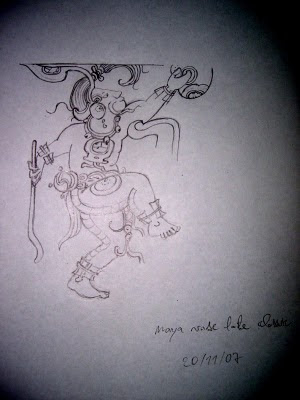
A cópia fiz em 2007, o original é de mais de 1000 anos antes. / I drew this copy in 2007, the original one is over 1000 years older.

quarta-feira, 6 de janeiro de 2010

Intervalo

Interval

Ultimamente tenho percebido cada vez mais claramente como as nossas vidas estão imbutidas em intervalos. A simples pergunta “Como vai?” deixa isso bem claro. Se pararmos pra pensar, estando bem ou mal agora, é só uma questão temporal, um intervalo entre a última vez que você esteve bem ou mal antes. Mais do que isso, às vezes esquecemos de como estávamos antes e o que fazer, ou não, para mudar o agora.

Lately, I’ve been perceiving clearer and clearer how much our lives are embedded in intervals. The simple question “How are you?” makes it clear. If we bethink, wether you are good or not now is just a matter of time, an interval between the last time you were good or bad before. Moreover, sometimes we forget how we were before and what to do, or not, to change now.

Um exemplo disso, que me fez refletir, foi minha viagem à Itália. Eu havia passado 3 meses na Rússia antes disso, e fui na Itália visitar meu irmão, para voltar e passar mais 3 meses na Rússia. O fato é que viagei tanto nesse período de cerca de um mês que passei fora que às vezes eu me esquecia do plano inicial. Eu estive em 6 cidades em dois países em cerca de 8 dias. Chegava a um ponto que eu me esquecia da minha meta inicial e até pelo fato de a viagem de volta ainda não estar completamente garantida (faltava fazer outro visto pra voltar) eu me sentia como se eu nunca fosse voltar a lugar nenhum. Eis que tudo passou, e agora, é como se eu nunca tivesse saído da Rússia. Percebi que tudo que vivenciei, tudo que passei, os lugares por onde passei, as coisas que experimentei, as pessoas que conheci, o ar que respirei, e tantas coisas mais foram apenas um intervalo entre 21 de novembro e 25 de dezembro (que, por sinal, não é natal aqui, mas sim, coincidentemente, hoje à noite, 6 de janeiro) de 2009.

An example, that made me wonder about this, was my travel to Italy. I had been in Russia for 3 months before it and went to Italy to visit my brother and then go back to Russia for more 3 months. The point is that I had been travelling so much then, in this period of about one month that I’ve been out, that sometimes I forgot the initial plan. I’ve been to 6 cities in 2 countries in about 8 days. Sometimes it came to a point that I even forgot that I had to go back to Russia, even because the way back was not 100% certain, as I still had to get another visa for heading back, and I eventually felt I was not going back anywhere anymore. Finally, everything is gone and now it’s like I never left Russia. I realized that everything that I’ve been through, all the places where I’ve been to, the experiences I had, the people I met, the air that I breathed and so much more things, were actually just a break between november 21 and december 25 (which, by the way, is not christmas here, coincidentaly it is tonight, january 6th), 2009.

Algo semelhante eu sentia quando trabalhava de madrugada e estudava de dia. Eu dormia das 9 da manhã até o meio-dia, ia pra faculdade e voltava por volta das 6 da tarde, pra dormir mais um pouco antes de voltar pro trabalho. Parecia que a faculdade era só um intervalo do meu sono, assim como quem dorme, acorda, bebe um pouco d’água e volta a dormir. Mais do que isso, minha vida era o intervalo do meu trabalho, uma mera pausa, já que eu voltava do trabalho às 9 da manhã e voltava pra lá às 9 da noite.

Something similar came to my mind when I worked night shift and studied day time. I slept from 9am to noon and then went to the university, and came back home around 6pm, to sleep a little bit more before going back to work. It looked like university was just a mere break in my sleep time, like when someone is sleeping, wakes up, drinks some water and goes back to sleep. Furthermore, my whole life was the interval of my job, a mere break, once I came back from work at 9am and went back there at 9pm.

Certamente, quando eu voltar pro Brasil, encerrarei mais esse intervalo que foi a Rússia (Alemanha, Itália e Vaticano, exterior, de um modo geral), mas aí me pergunto: e se eu voltar?
O que determina tudo é a quantidade, e, porque não dizer, a intensidade. Por isso, pessoas me acham otimista quando alguém me diz que está com dor de cabeça, e eu respondo “que bom! Sinal de que geralmente você não tem dor de cabeça, de outro modo você estaria feliz quando não a tivesse”. Mas essa é a verdade, e a vida é uma alternância constante de valores, o bem e o mal, a dor e o prazer, a tristeza e a alegria, dias úteis e fins-de-semana e por aí vai. Um depende da existência do outro e por vezes são relativamente idênticos, como quando eu trabalhava literalmente todos os dias, pra mim, fins-de-semana e dias úteis eram iguais, assim como quando se está de férias, todos os dias são fins-de-semana ou feriados. A verdade é que são todos conceitos e nada disso rege a matéria.

Certainly, when I go back to Brazil, I’ll finish this interval that was Russia (and so Germany, Italy and Vatican, this whole period abroad, generaly), but then I wonder myself: what if I come back here?
The most important is the quantity, and, why not, intensity. That’s why people may think I’m an optimist when somebody tells me s/he has a headache and I retort “that’s good! It means that you usually don’t have headaches, otherwise you’d be glad when you don’t have one”. But that’s the truth, and life is a constant alternation of values, the good and the evil, pleasure and pain, sadness and happiness, work days and weekends and so on. One depends on the other's existence and some times they’re relatively identical, like when I worked literally every single day, for me, weekends and work days were completely alike, just like on vacations, all the days are like weekends or holidays. The truth is that they are all concepts and none of them rule the common matter.

ssa-sd-ssa

terça-feira, 29 de dezembro de 2009

A inexistência

The inexistence

Algo que sempre me fascinou foi especular sobre o que não existe. O que não ocorreu, o que não chegou, o que não nasceu, o que não vingou. Pode parecer perda de tempo, mas nós mesmos poderíamos nunca ter existido, e que diferença faria? Nenhuma, nem para nós mesmos, afinal, nunca teríamos existido. Acho graça ao imaginar quantos atletas fantásticos não estão nas olímpiadas por que nunca tiveram condições para se dedicar inteiramente ao esporte, quantos tiveram acidentes e não puderam praticá-lo, quantos tiveram que desistir... Quantos líderes mundiais morreram na infância, quantas chances do mundo ter sido outro foram perdidas porque gerações inteiras foram ceifadas em grandes guerras. E se no nosso mundo os mortos voltassem junto aos seus descendentes que nunca nasceram, como se tivessem sempre vivido? O meu maior amigo nunca nasceu porque seu tataravô morreu numa guerra ou foi vitimado por alguma doença. A cura para o càncer não foi encontrada porque seu inventor nunca nasceu.

Something that has always fascinated me is to think about what doesn’t exist. What didn’t happen, what didn’t arrive, what was never born, what didn’t grow up. It may sound like a waste of time, but even we could have never existed ourselves, and what would be the difference? None, neither for us, after all, we would have never existed anyway. I find it funny to imagine how many amazing athletes are not competing in the Olympic Games because they never had enough conditions for dedicating themselves entirely for the sport. How many had accidents and couldn’t practice it, how many had to give up… How many world leaders died in their childhood, how many chances the world lost of being different because whole generations perished in great wars. What if the dead came back together with their descendents that were never born, as if they had been living to this very time? My best friend was never born because his great grandfather died in a war or was killed by some illness. The cure for cancer has never been found because its inventor was never born.

Fico pensando se há uma vida como esta nossa após a morte, e, se realmente houver, lá haveria de ter gente como nós, gente bonita, feia, rica, pobre, preta, branca, jovem, velha, boa, má... Afinal idade, credo, cor ou índole não são critérios para a dona morte, que todos leva.
O que me encanta na inexistência é o espaço que ela reserva e a incerteza que ela nos deixa. Tudo que se pode ver e tocar é de certa forma vulnerável, limitável e dizível, mas o que não existe é divino, é supremo, é intocável, é intangível, é imortal. Talvez, de certa forma, esta tenha sido a razão pela qual passei meses sem escrever aqui, pois admiro a folha em branco e as infinitas possibilidades que ela encerra na sua simplicidade de ser vazia. Até porque tudo é relativo e assim, tudo que escrevo aqui é tão bom e útil quanto o nada. Talvez eu nunca devesse ter escrito nada, sequer estas palavras, que diferença faria? A essência delas está em todos nós, no que existe e no que inexiste, pois sem a existência a inexistência absorveria a ela mesma, não haveria diferença nem ninguém vivo capaz de notá-la.

I wonder if there’s a life like ours after death, and if there really is, there would be people exactly like us, beautiful, ugly, rich, poor, black, white, young, old, good, evil people... All in all, age, creed, skin color or personality are not criteria for lady Death, who takes us all.
What delights me on the inexistence is the space that it reserves and the uncertainty that it leaves for us. Everything that can be seen and touched is, somehow, vulnerable, limited and understood, but what doesn’t exist is divine, supreme, untouchable and immortal. Maybe, somehow, that’s the reason for me to have passed months without writing here, just because I admire the white sheet and the endless possibilities that it bears inside itself, on its way of being simply empty. Even because everything is relative and thus, all that I’m writing here is as good and useful as nothing. Maybe I should have never written anything, even these words. What would be the difference? Their essence is inside all of us, in what exists and in what inexists, for without the existence, the inexistence would absorb itself, there would be nobody alive, able to notice it.

Talvez seja por isso que existimos, para meditar sobre tamanho prodígio que é a criação e a ruptura do que não existia. A existência por si só não é completa, sem o outro. Se tudo existisse, o universo inteiro seria um caos, algo inimaginável. Então me ocorre o quão dependente é o equilíbrio do nosso mundo daquilo que não existe, do impensável, do inconcebível. Fico pensando nos olhos que nunca lerão o que aqui escrevo e o que ocorreria (ou não) se o lesse.

Maybe that’s why we exist, for meditating about such tremendous prodigy that is the creation itself and the rupture of what didn’t exist before. The existence alone is not complete, without its alter. If everything existed, the whole universe would be in chaos, something unimaginable. Then, it comes to my mind how dependent the balance of our world is on what doesn’t exist, of what cannot be thought, of what cannot be conceived. I wonder about the eyes who will never read what I write and what would happen (or not) if they did.

Até o ano que vem.

See you next year.

A relatividade da vida

The relativity of life

Quantas vezes corri apressado, preocupado, e tudo para, no final, descobrir que já era tarde demais. E aí, vem a calma. Quantas vezes corri apressado, preocupado, e tudo para, no final, descobrir que cheguei bem na hora. E aí, vem a calma. Soam parecidos? E o que dizer do amor e do ódio, sentimentos que parecem tão antagônicos mas em ambos o objeto do amor e do ódio é igualmente importante para aquele que ama ou odeia.
“Eu nunca vou te esquecer” pode ser uma jura de amor eterno ou de vingança mortal.

So many times I ran, in a hurry, worried, and so on, to eventually find out that it was too late. Then I calmed down. So many times I ran, in a hurry, worried, and so on, to eventually find out that I got on the right time. Then I calmed down. Do they sound alike? What about love and hatred, feelings that look so distant from each other but in both of them the object of love and hatred is equally important for the lover or hater.
“I will never forget you” can be a declaration of eternal love or mortal vengeance.